A process FMEA, or pFMEA for short, is a structured method to find and reduce risks in a production process. FMEA stands for Failure Mode and Effects Analysis. For each process step you look at what can go wrong, what the effect would be, and how you prevent it or detect it in time.
Why a pFMEA?
A pFMEA helps you prevent problems instead of solving them afterwards. That means less scrap, fewer complaints and a higher yield. In automotive (IATF 16949) and aerospace (AS9100 and AS9145) a pFMEA is a fixed requirement, but outside those sectors it is also one of the most effective quality tools.
The structure of a pFMEA
For each process step you record:
- Requirement or characteristic: what should the step deliver? For example a hole diameter of 8.50 ± 0.05 mm.
- Failure mode: how can it go wrong? For example: diameter too large.
- Effect: what does the customer or the next process step notice?
- Cause: what causes the failure mode? For example: worn tooling.
- Current controls: prevention (avoiding it) and detection (finding it).
- Scores: Severity, Occurrence and Detection, each from 1 to 10.
- Actions: what do you do to reduce the risk further, who owns it and when is it done?
The seven steps according to AIAG-VDA
The 2019 AIAG-VDA FMEA Handbook describes seven steps:
- Planning and preparation: scope, team and timing.
- Structure analysis: which process steps, machines and people are involved?
- Function analysis: what should each step do, and which requirements must the result meet?
- Failure analysis: failure modes, effects and causes.
- Risk analysis: scoring and prioritising, with RPN or Action Priority.
- Optimisation: defining and carrying out actions.
- Results documentation: recording and communicating.
Read more about scoring in RPN or Action Priority: what is the difference?
Links with other documents
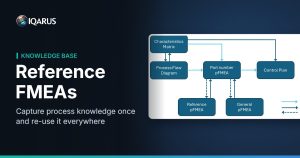
A pFMEA does not stand on its own. The process steps come from the Process Flow Diagram, the characteristics from the drawing and the Characteristics Matrix. The controls carry through to the Control Plan. When something changes in the process, all of these documents need to change with it.
Where it often goes wrong
In practice, things often go wrong in the same places:
- The pFMEA is created once before the production start and never updated afterwards.
- For a new product an existing FMEA is copied, without reviewing the risks.
- Lessons from complaints and improvements are not added to all FMEAs.
Read more in FMEA in Excel: 5 pitfalls.
Tip: work with reference FMEAs
Many risks are the same for a process, whatever product you make. By capturing them once in a reference FMEA and re-using it, you save time and keep all your pFMEAs up to date.
Ready to get started? With IQARUS you create linked pFMEAs, Process Flow Diagrams and Control Plans, with reference FMEAs that keep everything up to date. Try IQARUS free for 3 months, no account needed.